



A landlord may charge regular pet rent while an ESA accommodation request is pending, depending on the circumstances. However, once the request is approved, the landlord generally cannot charge pet rent or separate pet fees for a qualifying ESA under the Fair Housing Act. If you paid such charges, you can ask the landlord to review and adjust them.
Renting a home with an emotional support animal (ESA) can raise questions about additional costs. You may wonder whether your landlord can charge monthly pet rent, ask for a separate pet deposit, or add fees because you have an emotional support animal.
In most cases, the answer is no. Under the Fair Housing Act (FHA), eligible tenants can request reasonable accommodations for assistance animals, including emotional support animals. When an accommodation is approved, the animal is not treated as an ordinary pet. This means standard pet fees and deposits generally do not apply.
However, tenants should understand a few important exceptions, including responsibility for property damage and differences in state and local housing laws.

Can a Landlord Charge ESA Pet Rent?
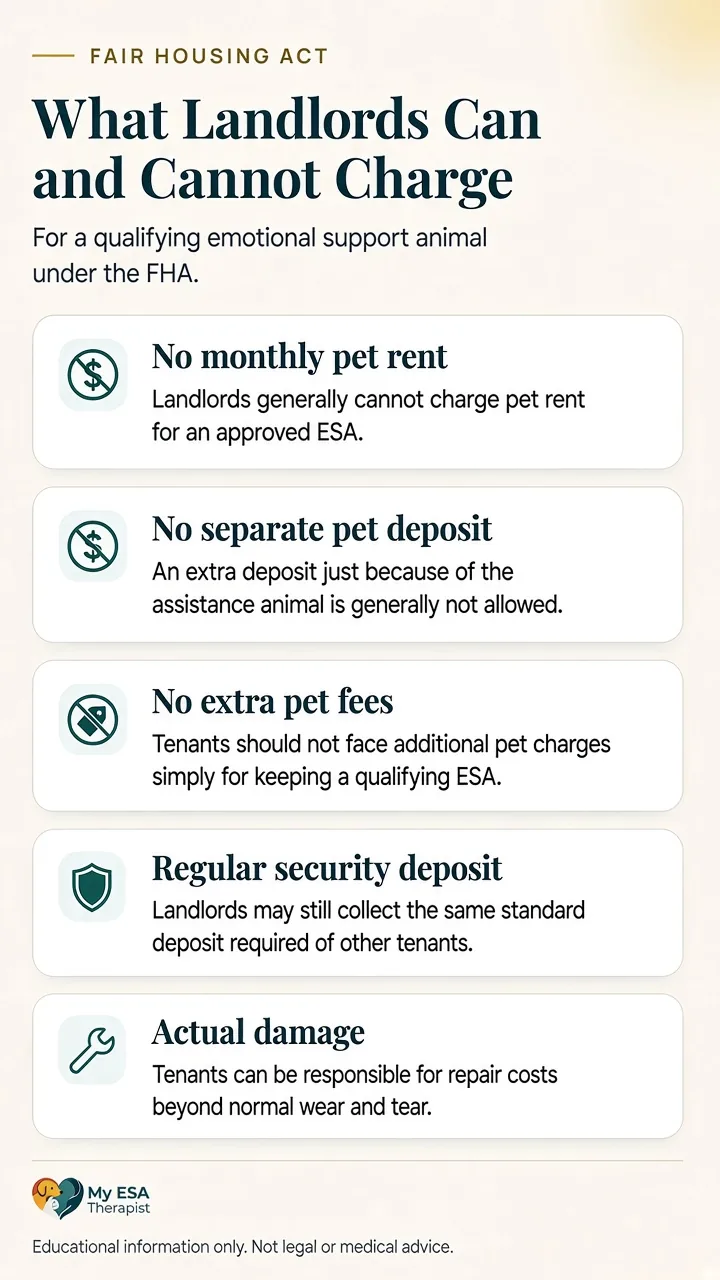
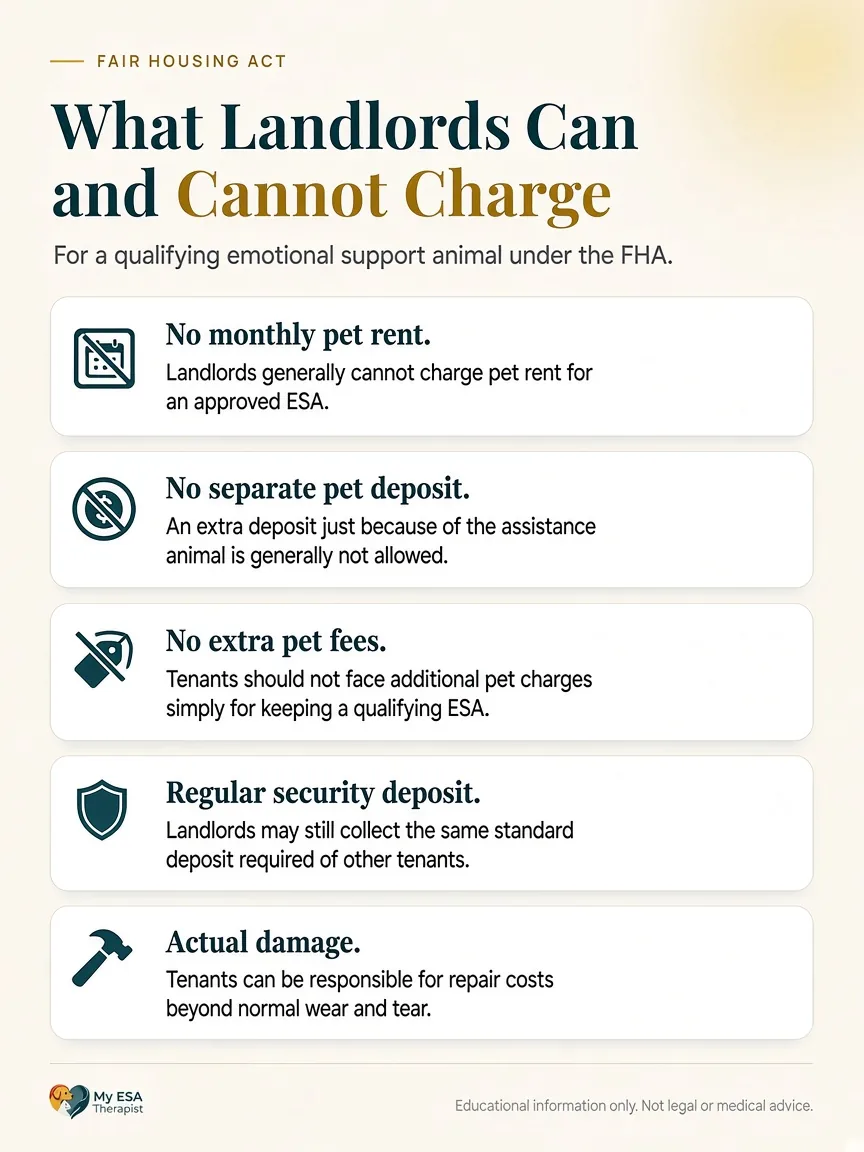
Generally, a landlord cannot charge monthly pet rent for a qualifying emotional support animal when a reasonable accommodation applies.
Pet rent is an additional monthly fee that landlords typically collect from tenants who keep ordinary pets. An ESA is different because it is not considered a pet; it provides emotional support that helps relieve one or more effects of a person's disability.
Under the Fair Housing Act (FHA), qualifying assistance animals are not considered pets. This means landlords may need to make exceptions to their regular pet policies, including allowing an ESA in a property that does not normally permit animals and not charging pet fees for the ESA since it is not a pet.
For tenants with an approved ESA accommodation:
- Landlords generally cannot charge monthly pet rent for the ESA.
- A no-pet policy may need to be adjusted to allow for the assistance animal.
- Tenants should not face additional pet charges simply for keeping a qualifying ESA.
Can a Landlord Require an ESA Pet Deposit?
Generally, landlords cannot require a separate ESA deposit as a condition of allowing a qualifying assistance animal.
Pet deposits are usually collected to cover potential damage caused by ordinary pets. However, the FHA recognizes waiving pet deposits, fees, and similar charges as additional forms of reasonable accommodations.
This means a landlord generally cannot collect an additional ESA pet deposit simply because a tenant needs an emotional support animal.
There is one important distinction: Landlords may still collect the regular security deposit required under the lease, provided the same rules apply to other tenants. The restriction is on charging an additional deposit specifically because of the assistance animal.
Can a Landlord Deduct ESA Damage From a Security Deposit?
Yes. Being exempt from pet fees does not mean tenants are exempt from responsibility for property damage.
If an emotional support animal damages a rental property beyond normal wear and tear, the landlord may be able to recover the actual repair costs under the lease and applicable state law.
For example, if an ESA scratches the flooring or damages a door, the tenant may be responsible for the repairs to the property.
However, this is different from collecting an extra deposit before any damage occurs. Any deduction from a regular security deposit must follow applicable state and local housing laws.
What Does the Fair Housing Act Say About ESA Pet Fees?
The Fair Housing Act protects people with disabilities from certain forms of housing discrimination. It requires covered housing providers to make reasonable accommodations to their rules, policies, and practices when necessary to give people with disabilities an equal opportunity to enjoy their homes.
For ESA renters, this may mean allowing an emotional support animal despite a no-pet policy for a property, or a landlord waiving standard pet-related fees.
The FHA's assistance-animal guidance identifies waiving pet deposits and fees as examples of reasonable accommodations.
There is also a recent legal development worth understanding. The United States Department of Housing and Urban Development (HUD) issued updated assistance-animal guidance in May 2026. According to the National Association of REALTORS®, this guidance does not automatically bind private litigants, state agencies, or courts. State and local fair housing laws may provide additional protections.
For this reason, tenants should consider the housing rules that apply in their area rather than assuming every situation follows exactly the same requirements.
What Can a Landlord Legally Ask for When Someone Has an ESA?
A landlord may request reliable supporting information when a tenant asks for an ESA accommodation and the disability or disability-related need for the animal is not apparent.
The information requested should help establish:
- That the person has a qualifying disability, when it is not already apparent or known.
- The connection between the individual's disability and the need for an assistance animal.
- How the animal helps address the effects of the disability.
Landlords should not demand unnecessary medical details or impose unreasonable documentation requirements on the individual requesting accommodation.
An ESA letter from a qualified healthcare professional may help support an accommodation request. Legitimate telehealth evaluations should not automatically be rejected simply because they take place online.
However, an online ESA registration, certificate, or ID card alone does not establish a disability-related need for an ESA.
What Should You Do If a Landlord Charges Pet Fees for an ESA?
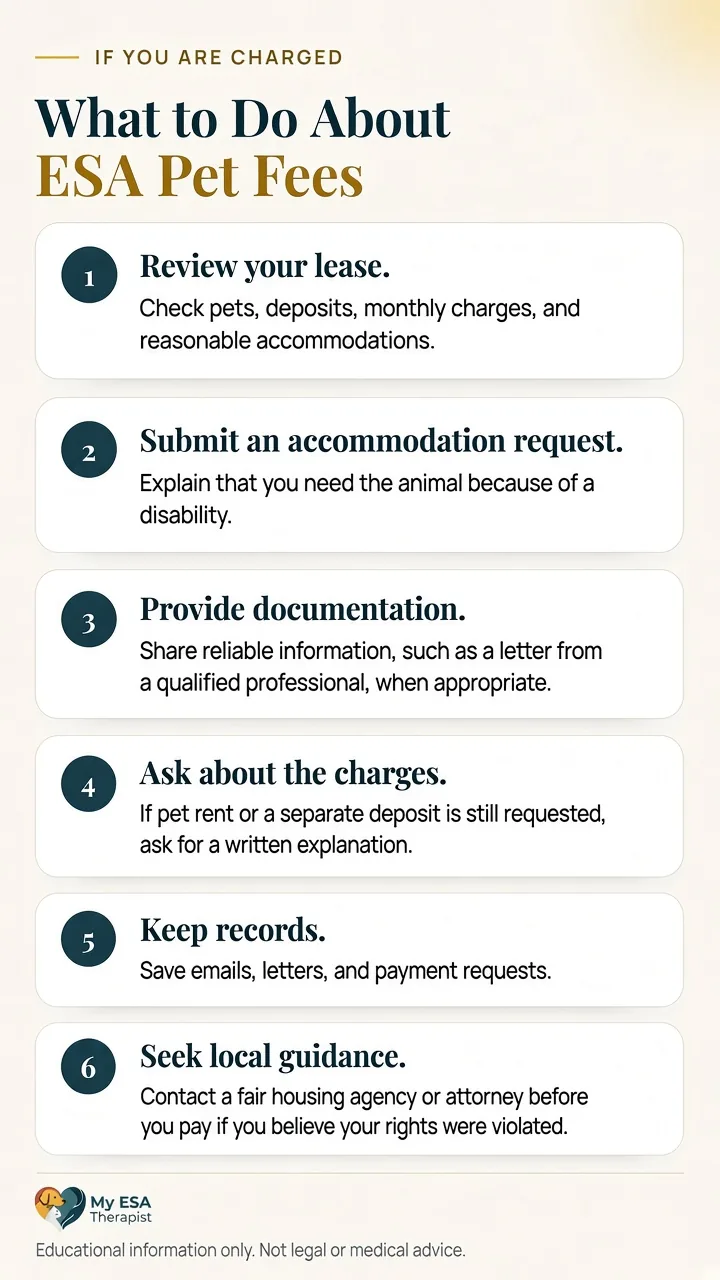
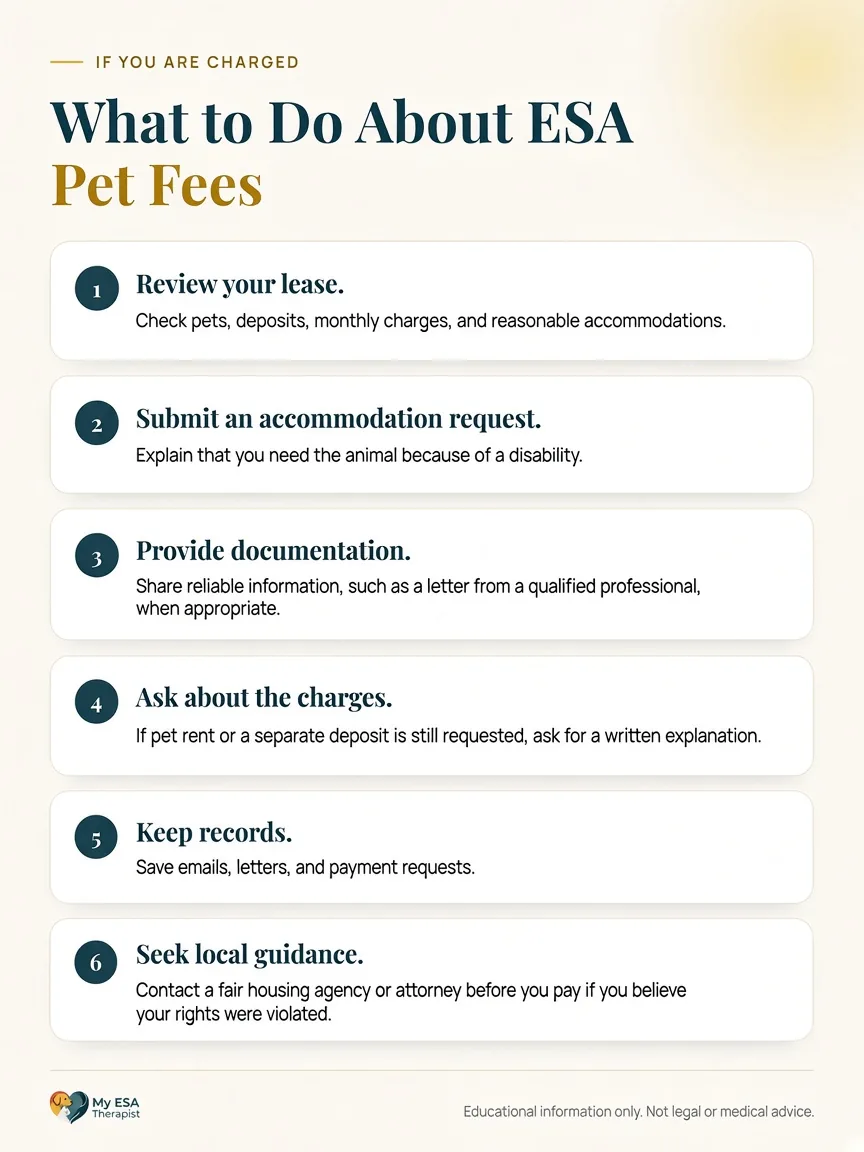
If your landlord asks you to pay pet rent or an additional deposit for your emotional support animal, review the request before making any payment.
A few practical steps can help:
Review your lease
Check the sections covering pets, deposits, monthly charges, and reasonable accommodations.
Submit an accommodation request
Explain that you need to keep an emotional support animal as an accommodation related to your disability.
Provide supporting documentation
If legally appropriate, share reliable information establishing your disability-related need for the animal, such as a letter by a qualified healthcare professional asserting your disability needs.
Ask about the charges
If your landlord still requests pet rent or a separate deposit, ask for an explanation regarding the charge in writing.
Keep communication records
Save emails, letters, payment requests, and other relevant documents.
Seek local guidance
Contact a fair housing organization, state civil rights agency, or qualified attorney if you believe your rights have been violated. Contact one of these agencies for support prior to making any payment.
Keeping communication in writing can help prevent misunderstandings and provide a record if a disagreement develops.
Frequently Asked Questions About This ESA Topic
Answers from this article about eligibility, housing, and the evaluation.
01Can a landlord charge monthly pet rent for an emotional support animal?
02Can a landlord charge a nonrefundable pet fee for an ESA?
03Do I have to pay a regular security deposit if I have an ESA?
04Can a landlord refuse an ESA because the property has a no-pet policy?
05Does an ESA letter automatically mean I can avoid pet fees?

Allyson Valley
I’m a Licensed Professional Counselor (LPC-MHSP), Ph.D. in Counselor Education & Supervision, with over six years of experience leading and delivering care across crisis services, behavioral health programs, and healthcare systems.
See full bioYour Next Step
ESA documentation is issued only after an evaluation by a licensed professional. These pages explain the process and requirements.



- Evaluation by a clinician licensed in your state
- $99, no hidden fees
- Secure, HIPAA-compliant telehealth