
HUD ESA Guidance 2026: What Changed for Emotional Support Animal Housing?

Written by:
Allyson Valley
Licensed Clinical Social Worker
June 09, 2026
Last updated: June 09, 2026

Medically Reviewed by
Max Phillips
MSW, LCSW
Table of Contents
For years, emotional support animal (ESA) accommodations in housing followed a relatively clear path: Tenants with valid documentation could request reasonable accommodations under the Fair Housing Act (FHA), and housing providers were generally expected to comply. That changed significantly on May 22, 2026, when the U.S. Department of Housing and Urban Development (HUD) issued new enforcement guidance that reshaped how ESA-related housing complaints are handled.
So, what exactly changed, and what does it mean for tenants with emotional support animals?
HUD Has Withdrawn Previous ESA Guidance
With those guidelines removed, landlords and tenants now face a much less standardized process.
HUD is Using a Service Animal Standard for Enforcement
The new guidance shifts HUD’s enforcement approach closer to the Americans with Disabilities Act (ADA) model.
Under this approach, HUD says it will focus on animals that are individually trained to perform disability-related work or tasks. Under the new guidance, untrained emotional support animals (ESAs) are no longer expected to receive the same enforcement treatment as trained service animals. Additionally, emotional support, comfort, or companionship alone are no longer considered disability-related tasks by HUD.
Importantly, this guidance changes HUD’s enforcement priorities and not the text of the Fair Housing Act (FHA). The FHA itself has not been amended, and its reasonable accommodation requirements remain in place. Instead, HUD has withdrawn earlier ESA guidance and indicated that it will generally stop pursuing FHA complaints involving untrained ESAs.
Many states also rely on the FHA framework when examining housing discrimination disputes, while others maintain independent fair housing laws that may provide broader protections. As a result, housing rights for ESA owners may now depend more heavily on state-level laws and enforcement agencies.
This shift primarily affects federal FHA complaint enforcement. State ESA laws, private lawsuits, and other disability protections may still apply depending on the jurisdiction.
Emotional support animals that primarily provide comfort through companionship, without specialized task training, may no longer receive the same federal enforcement support when disputes arise.
ESA Housing Requests May Face More Scrutiny
Under previous guidance, many landlords assumed denying a legitimate ESA request could trigger a housing complaint. That assumption is changing.
The updated policy removes the prior expectation that untrained ESAs should automatically receive accommodation consideration through HUD complaint channels. In practical terms, this could mean:
- More documentation requests from landlords
- Increased scrutiny during accommodation reviews
- Greater variation between housing providers
- More reliance on state-level protections
For tenants, preparation and documentation may become even more important moving forward. Many landlords and housing providers are expected to update their pet and assistance animal policies to clarify the distinctions between specifically trained disability service animals and untrained emotional support animals, often in accordance with applicable state laws and local jurisdictional requirements.
Because enforcement standards may now differ more significantly across jurisdictions, tenants may need stronger documentation supporting both their disability-related need for accommodation and an understanding of the protections available under their state’s housing laws.

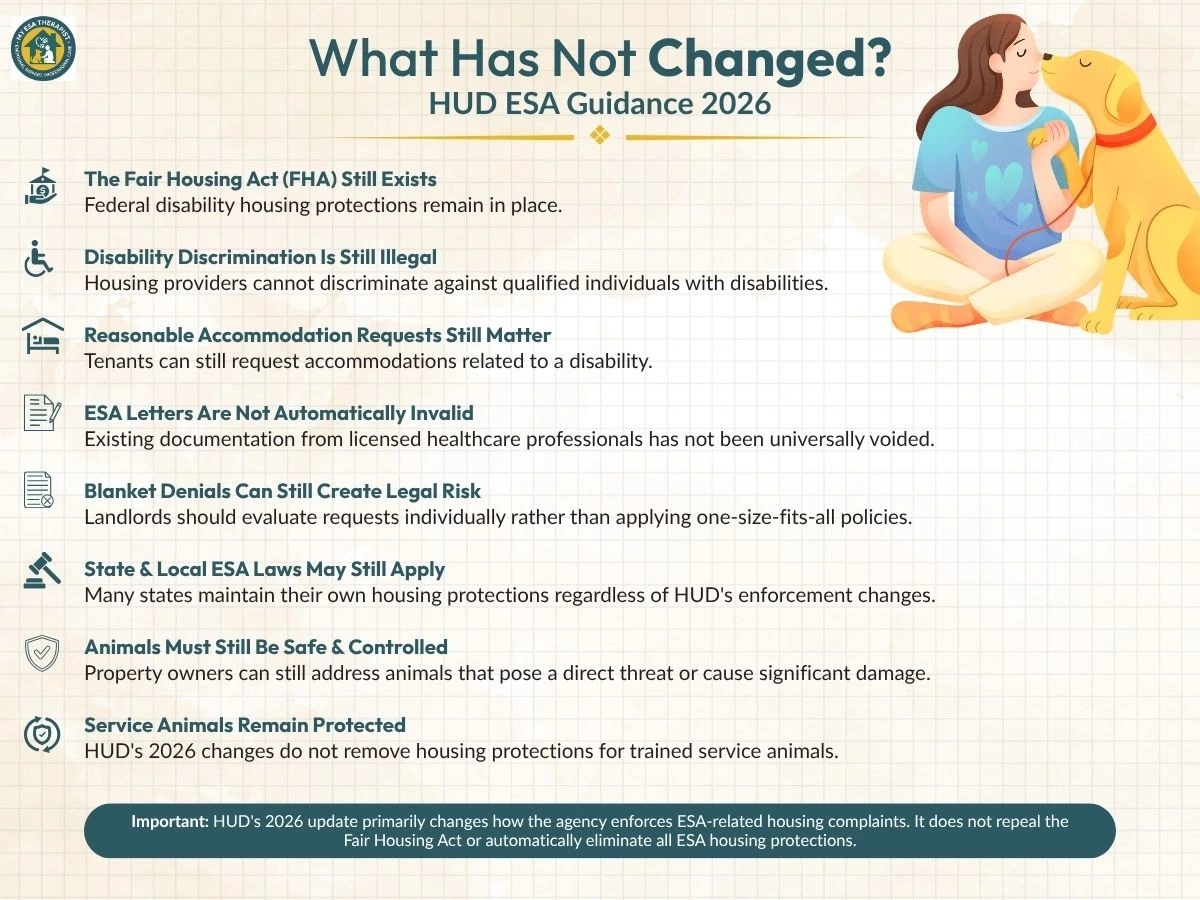
What Has Not Changed?
Despite headlines surrounding the policy shift, several important protections remain in place:
State laws still matter. Many states maintain housing protections that operate independently of HUD enforcement.
Private legal options remain available. Courts can still review housing discrimination claims.
Existing approvals usually stay intact. If your accommodation was already approved, this guidance does not automatically revoke it.
The Fair Housing Act still exists, and disability accommodation requirements have not been removed. Congress has not changed the law, and housing providers are still subject to reasonable accommodation obligations under federal law.
Importantly, this new policy does not apply equally across all housing programs. The guidance is limited to Fair Housing Act complaints handled by HUD and does not extend to other disability protections.
For example, public housing authorities and housing providers that receive federal financial assistance may also be subject to Section 504 of the Rehabilitation Act, which maintains its own reasonable accommodation requirements independent of the FHA. HUD’s guidance explicitly does not change these obligations. As a result, tenants living in public housing or HUD-assisted housing may still have stronger legal grounds to pursue accommodations or challenge denials under Section 504, even when filing an FHA complaint through HUD has become more difficult.
Understanding this distinction matters because enforcement guidance and federal law are not the same thing. Any currently open ESA cases will be reviewed on a case-by-case basis.
Does Your ESA Letter Still Matter?
Yes, documentation remains important.
A letter from a licensed mental health professional still serves as evidence supporting disability-related accommodation requests. However, the quality of documentation may matter more than ever.
Housing providers increasingly look for:
- Legitimate clinical evaluations
- State-licensed providers
- Clear accommodation recommendations
- Documentation connected to an ongoing therapeutic relationship
This is one reason many applicants now prioritize working with licensed professionals rather than relying on instant approval websites or generic documentation services.
At the same time, some attorneys and housing discrimination advocates may increasingly focus their cases on disputes involving specifically trained service animals, since these claims may align more closely with HUD’s current enforcement framework.
The impact of these changes may vary significantly by state. States with limited or no state-specific ESA protections, such as Missouri, could see larger practical implications because residents may have fewer independent legal pathways outside federal enforcement.
Meanwhile, states with stronger state-level housing protections, including Colorado and California, may continue offering broader protections for ESA accommodations through their own laws and enforcement agencies.
Because state protections now matter more, housing guidance and state-specific resources may require regular updates to reflect evolving local requirements and enforcement standards.
Need Documentation for an ESA Housing Request?
What Should Tenants Do Next?
Consider these practical steps:
- Keep accommodation requests in writing
- Maintain updated documentation
- Research your state’s housing protections
- Save copies of landlord communications
- Seek professional guidance before paying unexpected pet fees or withdrawing requests
What Should You Do If Your Landlord Denies Your ESA Request?
If your landlord denies your request, do not assume HUD is your only or primary reporting path. Because HUD has limited its enforcement focus for untrained ESAs, many tenants may need to rely more heavily on state agencies, disability rights organizations, fair housing groups, or private legal remedies.
If your request is denied:
- Document everything in writing and keep records of all interactions
- Gather supporting documentation showing your disability-related need for accommodation
- Contact local fair housing organizations or disability rights groups that understand state-specific protections
- Review whether your housing falls under additional protections, such as public housing rules or federally assisted housing requirements
- Avoid immediately agreeing to pet fees or withdrawing your request before understanding your legal options
State protections may now play a larger role than federal enforcement. For instance, California maintains more comprehensive housing and disability protections through state legislation and enforcement organizations, which might offer tenants who are denied accommodations more options. Other states may offer fewer independent protections, making local legal guidance especially important.
Final Thoughts
HUD’s 2026 ESA guidance represents a major shift in federal enforcement priorities, but it does not eliminate emotional support animal housing protections entirely.
For tenants, the landscape is becoming more documentation-focused and more dependent on state laws, private legal remedies, and properly supported accommodation requests.
Understanding these changes can help applicants prepare stronger requests and avoid confusion during the housing process.
Furthermore,, HUD has indicated that this guidance may not be the final step. The agency has stated that it intends to pursue formal rulemaking to update assistance animal regulations and align them more closely with disability service animal standards used under the ADA. However, HUD has not provided a timeline for when proposed rules or formal updates may be released.
Any future regulatory changes would likely go through the federal notice-and-comment process, which can take significant time and allows for public input, revisions, and potential legal challenges. Because of this, the regulatory landscape around ESAs and housing accommodations may continue evolving over the coming years.
As policies continue changing, informed tenants who maintain strong documentation, understand their state protections, and stay updated on legal developments are often better positioned to protect their housing rights.
Frequently Asked Questions
Does HUD require ESA registration or certification?
Can a landlord require ESA training certificates?
Can a landlord limit the size or weight of an ESA?
Has the Fair Housing Act changed in 2026?
About the Author

More ESA Resources

ESA for Children and Minors: How It Works and Who Signs the Letter?
Learn how children qualify for an emotional support animal, who can sign an ESA letter for minors, and what parents need to know about the evaluation process, housing, and school accommodations.

Is ESA Registration Legit or Required? The Truth About ESA Registration.
Many people believe registering an emotional support animal (ESA) makes it legally recognized, but that’s a common misconception. This article explains why ESA registration, certificates, and ID cards generally have no legal standing, what documentation actually matters for housing accommodations, and how to avoid misleading ESA registration services.

How to Verify If an ESA Letter Is Legitimate: A Landlord & Tenant Checklist.
Not all ESA letters are valid. Use this landlord and tenant checklist to verify ESA documentation, identify warning signs of fraudulent letters, and understand what makes an ESA letter legitimate.
Make My ESA Therapist a Preferred Source on Google
Liked this article? Add us as a preferred source and see our latest ESA guides, housing rights updates, ESA training tips, and state ESA law news more often in your Google Top Stories.