
ESA Letter Sample: What Does a Legitimate ESA Letter Look Like?

Written by:
Allyson Valley
Licensed Clinical Social Worker

Medically Reviewed by
Max Phillips
MSW, LCSW
Table of Contents
If you’re applying for housing accommodations with an emotional support animal, one of the most common questions is, “What does a legitimate ESA letter actually look like?”
With thousands of websites selling instant approvals and downloadable templates, it has become increasingly difficult for tenants and landlords to differentiate a valid ESA letter from an invalid one. In 2026, a legitimate emotional support animal letter follows specific professional and legal standards, particularly for housing requests under the federal fair housing framework.
This guide explains exactly what information should appear in a valid ESA letter and what should not be included, and provides a realistic ESA letter sample for educational purposes.
What Must a Legitimate ESA Letter Include?
While the exact wording can vary between clinicians, a legitimate ESA letter typically includes the following components:

Licensed Mental Health Professional's Information
The letter should clearly identify the licensed professional who conducted the evaluation, including:
- Full name
- Professional license type
- License number
- State of licensure
- Practice address or contact information
The clinician issuing the letter must be legally authorized to practice in the state where the patient resides.

Confirmation of a Qualifying Mental or Emotional Disability
A valid ESA letter should state that the individual has a mental or emotional disability recognized under applicable disability standards.
The letter does not need to disclose the specific diagnosis. Housing providers generally cannot require tenants to reveal private medical details simply to request accommodation.

Clinical Determination of Need
The letter should explain that the licensed professional has determined that the emotional support animal provides support or therapeutic benefit related to the individual’s condition.
This is one of the most important elements because the existence of a diagnosis alone does not automatically justify an ESA recommendation; there must be documented ways in which the ESA helps manage the disability.

Recommendation for Housing Accommodation
The letter should specifically recommend the presence of the emotional support animal as part of the individual’s treatment or symptom management plan and support the request for reasonable housing accommodation.
Signature and Date
A legitimate ESA letter includes the following:
- The clinician’s signature, not simply a typed name
- Date of assessment and letter issuance
- Professional letterhead for the mental health clinician’s place of employment
Unsigned letters, generic certificates, or automated PDFs without provider information are major red flags.
ESA Letter Sample
Date
To Whom It May Concern,
I am a licensed mental health professional currently providing care to [Patient Name]. I am a licensed mental health professional in the state of [STATE] with an active license to practice. I have training in ESA assessments and letters. I met with [NAME] on [ASSESSMENT DATE] to provide an ESA assessment.
Based on my professional evaluation, I have determined that this individual [NAME] has a mental or emotional health condition recognized in the DSM-5. The presence of an emotional support animal is recommended as part of their ongoing treatment and helps alleviate symptoms associated with their condition. The ESA helps this individual manage their disability by… [EXAMPLES]. I posit that this individual has the resources and means to sufficiently care for the animal.
Therefore, I recommend reasonable accommodation for this emotional support animal in housing settings for [NAME].
If additional information is required within the limits of applicable laws, please contact my office.
Sincerely,
[Provider Name]
[License Number]
[State]
[Contact Information]
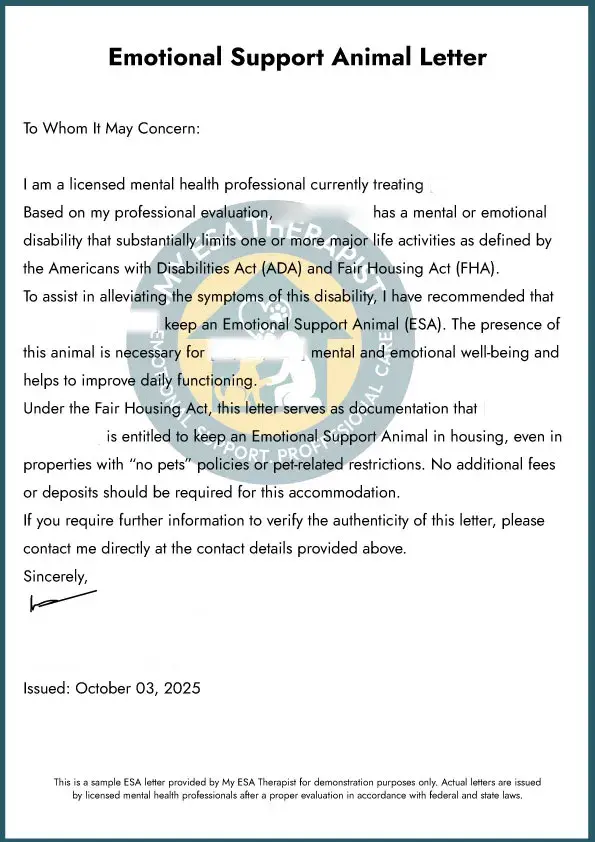
Disclaimer: The following sample is for educational purposes only and should not be copied or used as a substitute for documentation issued by a licensed mental health professional.
What a Legitimate ESA Letter Does Not Include?
Many fake ESA websites continue to sell documents that look official but have little to no legal value. A legitimate ESA letter does not rely on the following:
- ESA registration numbers
- National ESA databases
- ID cards or badges
- Animal certifications
- Vests or patches
- Lifetime approvals
- Instant approvals without evaluation
There is currently no federal ESA registry in the United States, and landlords cannot require registration documentation because no official government registry exists.
Does ESA Registration Actually Mean Anything?
Can Landlords Verify an ESA Letter?
Yes. Housing providers are generally allowed to verify the following:
- The letter was issued by a licensed professional.
- The provider holds an active license.
- The documentation appears authentic and was issued as part of a professional relationship following an ESA evaluation.
However, landlords generally cannot demand access to medical records or require disclosure of a specific diagnosis. The purpose of verification is to confirm the legitimacy of the documentation, not to inquire about an individual’s private medical history.
Want to learn more about the verification process? Read our guide:
How to Verify If an ESA Letter Is Legitimate: A Landlord & Tenant Checklist
Summing Everything Up
A legitimate ESA letter is relatively simple in terms of looks but significant in what it represents. It should come from a licensed mental health professional, document a disability-related need for an emotional support animal, and support a housing accommodation request.
If a document focuses more on registration numbers, certificates, or accessories than on a professional clinical evaluation, it is likely not the type of documentation housing providers are looking for and may provide little to no housing protections.
When reviewing an ESA letter, the most important question is not whether it looks official, but whether it reflects a genuine evaluation conducted by a qualified licensed professional.
Need a Legitimate ESA Letter?
Get evaluated by a licensed mental health professional. If you qualify, you’ll receive a valid ESA letter for housing accommodations.
Frequently Asked Questions
What does a legitimate ESA letter sample look like?
Can I use an ESA sample as my official ESA letter?
What is the difference between an ESA letter and an ESA certificate?
What information should not appear in an ESA letter sample?
Does an ESA letter need to be renewed every year?
About the Author

More ESA Resources

ESA for Children and Minors: How It Works and Who Signs the Letter?
For children and minors, the...

Is ESA Registration Legit or Required? The Truth About ESA Registration.
No, ESA registration does...

How to Verify If an ESA Letter Is Legitimate: A Landlord & Tenant Checklist.
The easiest way to verify an...
Make My ESA Therapist a Preferred Source on Google
Liked this article? Add us as a preferred source and see our latest ESA guides, housing rights updates, ESA training tips, and state ESA law news more often in your Google Top Stories.