
Which DSM-5 Conditions Qualify for an ESA? A Condition-by-Condition Guide.

Written by:
Allyson Valley
Licensed Clinical Social Worker
July 10, 2026
Last updated: July 10, 2026

Medically Reviewed by
Max Phillips
MSW, LCSW
Table of Contents
More people across the U.S. are learning about different ways to support their mental health, including emotional support animals (ESAs). If you’re wondering what an emotional support animal is and whether your condition may qualify, this guide explains the basics and the conditions commonly considered.
An ESA is more than just a pet. It is an animal recommended by a licensed mental health professional to provide emotional support related to a person’s mental health condition. Unlike service animals, ESAs don’t require specialized training, but their presence can significantly improve an individual’s daily functioning and emotional stability.

What is an Emotional Support Animal?
To understand eligibility, it’s important to first answer: what is an emotional support animal?
An ESA is specifically trained to provide emotional and physical comfort, reduce depression and anxiety, and support overall mental well-being simply through companionship. Under federal housing laws, individuals with a valid ESA letter are entitled to certain protections even in “no-pet” housing.
ESA protections are connected to federal laws, including the Fair Housing Act and Section 504, which help protect people with qualifying disabilities from housing discrimination.
What Does "Qualifying Condition" Mean Under the Fair Housing Act?
Under the Fair Housing Act (FHA), a person qualifies for an emotional support animal if they have a disability, which is defined as a physical or mental impairment that substantially limits one or more major life activities. Mental health conditions that meet this criterion are largely drawn from the DSM-5 (Diagnostic and Statistical Manual of Mental Disorders, Fifth Edition), the clinical reference used by licensed mental health professionals across the United States.
There is no official list of conditions that automatically qualify someone for an ESA. A licensed mental health professional looks at how a person’s symptoms affect daily life and whether an ESA may provide meaningful support. The ESA letter they write is the documentation that establishes this.
Condition-by-Condition Guide

Anxiety Disorders: GAD, Social Anxiety Disorder, and Panic Disorder
Anxiety disorders involve persistent, excessive fear or worry that significantly interferes with daily life. Generalized Anxiety Disorder (GAD) produces chronic, wide-ranging anxiety about everyday situations across a variety of contexts and environments. Social anxiety disorder creates intense fear of social interaction. Panic disorder involves recurrent, unexpected panic attacks characterized by hyperventilation and a strong sense of dying, as well as ongoing fear of future panic attacks.
An emotional support animal helps by lowering cortisol levels, reducing heart rate during anxiety episodes, and providing grounding during moments of acute distress. An ESA can make it easier for people with social anxiety to adjust to new situations and gradually lessen avoidance behavior. Anxiety disorders are among the most commonly cited qualifying conditions for an ESA letter. ESAs can be trained to recognize when an individual’s anxiety levels are increasing, sense heightened cortisol levels, and provide physical compression to help bring feelings of safety and security.
If you experience anxiety and are considering emotional support, learn more about whether you may qualify for an ESA for anxiety.

Depressive Disorders: Major Depressive Disorder and Persistent Depressive Disorder
Major Depressive Disorder (MDD) involves extended periods of feeling down, depressed, or hopeless; little interest or pleasure in doing things; difficulty falling asleep, or sleeping too much, chronic fatigue, poor appetite or overeating; and difficulty concentrating. It can also include suicidal ideation. Persistent Depressive Disorder, formerly called dysthymia, is a chronic, lower-grade depression lasting two years or more. Bipolar depression looks similar to MDD; however, it alternates with periods of mania or hypomania (bipolar as a whole will be explored later on in this article). All of these mood disorders can profoundly limit a person’s ability to function at work, in relationships, and at home.
Caring for an animal creates a natural daily structure, like feeding schedules, walks, and interaction, which can be especially therapeutic for people with depression who struggle with motivation and routine. Physical touch and the consistent companionship of an animal also stimulate the release of oxytocin and serotonin, neurotransmitters associated with mood regulation. ESAs can be trained to help prompt someone dealing with depression to get out of bed, eat food, take a shower, or get outside the house.

PTSD and Trauma-Related Disorders
PTSD develops after exposure to a traumatic event and is characterized by disturbing memories or flashbacks, hypervigilance, increased startle response, emotional numbing, feeling distant and detached from other people, avoidance of trauma-related triggers, and significant disruption to daily functioning. It can also involve suicidal ideation. PTSD can affect veterans, survivors of abuse and accidents, and other traumatic experiences. Acute stress disorder follows a similar pattern in the immediate aftermath of trauma; if the trauma symptoms persist for over 30 days after the traumatic experience, it can develop into PTSD.
Emotional support animals are well-recognized as therapeutic companions for trauma survivors. An ESA can provide a steady, nonjudgmental presence that builds a sense of safety, stops hypervigilance reactions, and offers consolation during nightmares or flashbacks. Many therapists working with trauma actively recommend ESAs as part of a broader treatment approach. ESAs can be trained to help wake a person up during a nightmare, provide reminders for medication, and alert other people in the home that support is needed.
If you experience ptsd and are considering emotional support, learn more about whether you may qualify for an ESA for ptsd.

ADHD: Attention-Deficit/Hyperactivity Disorder
ADHD is a neurodevelopmental disorder marked by persistent inattention, hyperactivity, or impulsivity that interferes with functioning or development. ADHD can make it difficult to modulate attention and motivation, leading to difficulties starting tasks and transitioning to other tasks. While commonly associated with children, ADHD persists into adulthood for the majority of those diagnosed and can significantly affect professional performance, relationships, and daily self-management.
Caring for an animal creates an external structure and routine, which can be particularly beneficial for individuals who struggle with time management and task initiation. The calming presence of an ESA also supports the emotional regulation difficulties that frequently accompany ADHD in adults, including difficulties with anger and overwhelm. When ADHD substantially limits major life activities, it qualifies as a disability under the Fair Housing Act. Some states require an ADHD diagnosis to be tested and confirmed by a PhD-level provider.

OCD: Obsessive-Compulsive Disorder
OCD is characterized by persistent intrusive thoughts (obsessions) and repetitive behaviors or mental acts (compulsions) performed to reduce distress. The cycle of obsessions and compulsions can be time-consuming and significantly affect a person’s ability to carry out daily activities, maintain relationships, and hold employment.
An emotional support animal provides comfort during periods of heightened anxiety triggered by obsessive thought cycles and can help draw attention to compulsive behaviors.

Bipolar Disorder: Type I and Type II
Bipolar disorder involves extreme shifts in mood, energy, and functioning, ranging from manic or hypomanic episodes to depressive episodes. These transitions can be unpredictable and disruptive, making consistent employment, relationships, and self-care challenging to keep up over time.
An ESA can provide a stabilizing daily routine during depressive episodes, while the responsibility of animal care may also serve as a grounding anchor during periods of elevated mood or impulsivity. Many individuals with bipolar disorder find that their ESAs’ consistent needs create a reliable external structure that supports mood regulation alongside medication and therapy.

Phobias and Agoraphobia
Specific phobias involve an intense, irrational fear of a particular object or situation, such as heights, flying, or enclosed spaces, that leads to significant avoidance behavior. Agoraphobia is a fear of circumstances from which escape may be challenging, which frequently results in avoiding public areas, transportation, or leaving one’s house completely. Both can dramatically restrict a person’s world when left unaddressed.
For individuals with agoraphobia or situational phobias, an ESA can make dealing with feared environments more manageable. The animal offers a comforting, familiar presence that lessens the severity of fear reactions and can facilitate gradual exposure, which is the primary strategy used to treat phobias.

Borderline Personality Disorder (BPD)
Borderline Personality Disorder is marked by intense emotional instability, a persistently unstable self-image; impulsive behaviors including self-harm and suicidality, and highly turbulent interpersonal relationships. Individuals with BPD may also experience episodes of dissociation, feeling disconnected from their sense of self and the world around them, and an intense fear of abandonment. The condition often significantly impairs social, occupational, and relational functioning.
For someone with BPD whose human relationships are frequently marked by perceived rejection or unpredictability, a steady, unconditional bond with an animal can be particularly comforting. An ESA’s predictable emotional availability provides a reliable connection that supports emotional regulation, particularly during periods of acute distress. ESAs can also help regulate a dissociated nervous system, bringing an individual back to their body and the present moment.

Schizophrenia and Other Psychotic Disorders
Schizophrenia is a serious mental illness characterized by hallucinations, delusions, disorganized thinking, and significant negative symptoms such as social withdrawal and flat affect. Related conditions include schizoaffective disorder and schizophreniform disorder. These disorders profoundly affect perception, cognition, and the ability to function independently.
In addition to medication and therapy, an ESA can help people with psychotic disorders in stable stages of treatment by reducing social isolation, providing grounding, and offering emotional support. ESA eligibility in these cases is typically evaluated in close coordination with a treating psychiatrist or physician, and documentation from the treating provider is often most appropriate.
Conditions That Usually Do Not Qualify and Why?
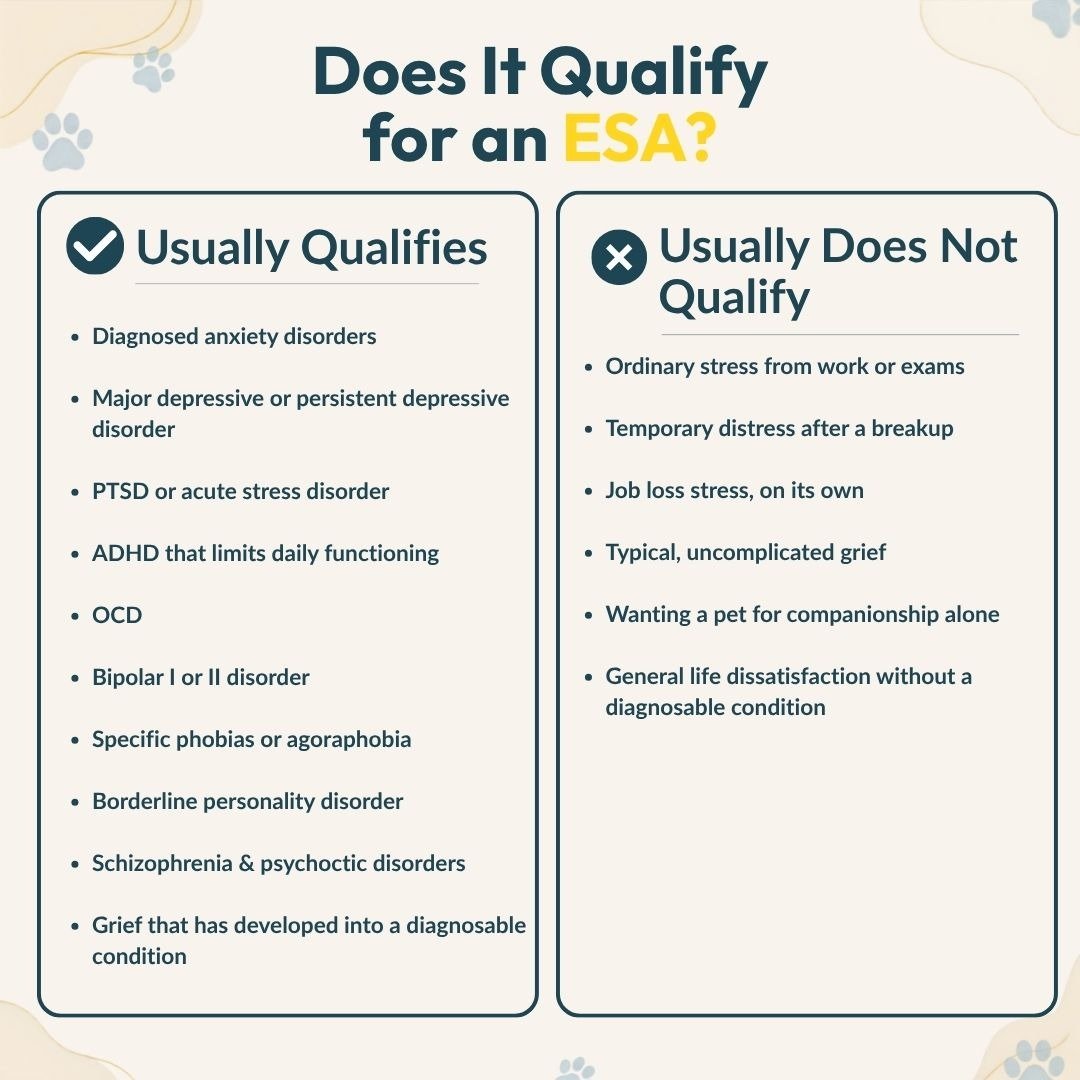
Not every type of emotional distress qualifies someone for an ESA. Temporary challenges, such as stress from a breakup, job loss, or exams, usually do not qualify by themselves because they are common life experiences. However, if these struggles develop into a diagnosed mental health condition that affects daily functioning, an ESA may be considered.
Typical grief after a loss does not automatically qualify one for an ESA either. An ESA is also not meant simply for companionship or personal preference. Eligibility depends on a person’s mental health needs and an evaluation from a licensed professional.
Mental health professionals consider the full picture, including symptoms, daily challenges, and how a person’s condition impacts their everyday life. A mental health professional can help differentiate between distress from life stressors versus a diagnosable mental health condition.
See If You're Eligible for an ESA Letter
A licensed mental health professional can evaluate your symptoms and determine whether an ESA letter is appropriate for your needs.
Frequently Asked Questions
Does ADHD qualify for an emotional support animal letter?
Can I get an ESA letter for anxiety without a prior diagnosis?
Does grief or bereavement qualify for an ESA?
Can more than one condition appear on an ESA letter?
Medical Disclaimer
This article is provided for general educational purposes only. It is not medical, psychological, or legal advice, and it is not intended to diagnose, treat, cure, or prevent any mental health condition. Reading it does not create a provider-patient relationship.
- No condition automatically qualifies you. The conditions discussed in this article are examples that a licensed mental health professional may consider. There is no official list of conditions that guarantees an ESA letter, and a diagnosis alone does not determine eligibility.
- Eligibility is decided individually. A licensed mental health professional must assess your symptoms, how they affect your daily life, and whether an ESA may provide meaningful support. Approval is never guaranteed, and requirements can vary by state and by condition.
- Descriptions of benefits are general, not guaranteed. How an emotional support animal may help with a condition reflects general observations. Individual experiences and results vary.
- An ESA is not a medical treatment. An emotional support animal is not a substitute for therapy, medication, or other professional mental health care. For many people, it is one supportive part of a broader treatment plan.
- An ESA is not a service animal. No task training or special skills are required, and an ESA letter does not grant public access rights. The housing protections that apply to ESAs require a recommendation from a licensed mental health professional. Laws can change, so consult a qualified professional or attorney about your situation.
- Do not change your care because of this article. Never stop, delay, or adjust any treatment or medication without first speaking with your doctor or therapist.
Need urgent help? If you are in crisis or thinking about harming yourself, call or text 988 (Suicide & Crisis Lifeline, U.S.). Veterans can dial 988 then press 1. For a medical emergency, call 911.
See our Terms of Use and Privacy Policy.
About the Author

More ESA Resources

8 Basic Obedience Commands Every ESA Should Know
Learn the 8 basic obedience commands every emotional support animal should know, from sit and stay to come, leave it, quiet, place, and heel. While ESA training isn’t legally required, these commands can help improve safety, behavior, and everyday life with your ESA.

ESA for Anxiety: Eligibility, Benefits, and How to Qualify
Anxiety may qualify someone for an emotional support animal when it substantially affects daily functioning. Explore the benefits of ESAs and the factors considered during an eligibility evaluation.

ESA Letter Sample: What Does a Legitimate ESA Letter Look Like?
This guide provides an ESA...
Make My ESA Therapist a Preferred Source on Google
Liked this article? Add us as a preferred source and see our latest ESA guides, housing rights updates, ESA training tips, and state ESA law news more often in your Google Top Stories.