
How to Verify If an ESA Letter Is Legitimate: A Landlord & Tenant Checklist.

Written by:
Allyson Valley
Licensed Clinical Social Worker
June 19, 2026
Last updated: June 19, 2026

Medically Reviewed by
Max Phillips
MSW, LCSW
Table of Contents
Emotional Support Animals (ESAs) play an important role in helping individuals manage mental and emotional health conditions. Landlords frequently receive ESA letters from tenants asking for reasonable accommodations because ESAs are eligible for housing accommodations under the Fair Housing Act (FHA). However, with the rise of online ESA services, fraudulent and invalid ESA letters have become increasingly common.
Understanding how to validate an ESA letter is crucial, whether you’re a landlord evaluating accommodation requests or a tenant looking for housing protections. This guide provides a practical checklist to help determine whether an emotional support animal letter is legitimate and compliant with current housing guidelines.
What is a Legitimate ESA Letter?
A legitimate ESA letter is a written recommendation from a licensed mental health professional (LMHP) stating that an individual has a qualifying mental or emotional health condition and benefits from the presence of an emotional support animal. The qualifying diagnosis itself does not have to be disclosed in the letter; a valid ESA letter should discuss how the ESA helps the individual with their disability.
A valid ESA letter must also have an accompanying mental health assessment by a licensed mental health professional.
An ID card, vest, online database listing, or registration certificate is not proof of a legit ESA letter. Rather, it is a formal medical record that backs up a request for housing accommodations.
Why ESA Letter Verification Matters?
For tenants, having a legitimate ESA letter helps ensure housing rights are protected and reduces the risk of accommodation denials.
Verification keeps landlords in compliance with fair housing laws while preventing fraud. Property owners have the right to review ESA documentation, but they must do so without violating a tenant’s privacy rights.
Understanding what makes an ESA letter valid can help both parties avoid unnecessary disputes.
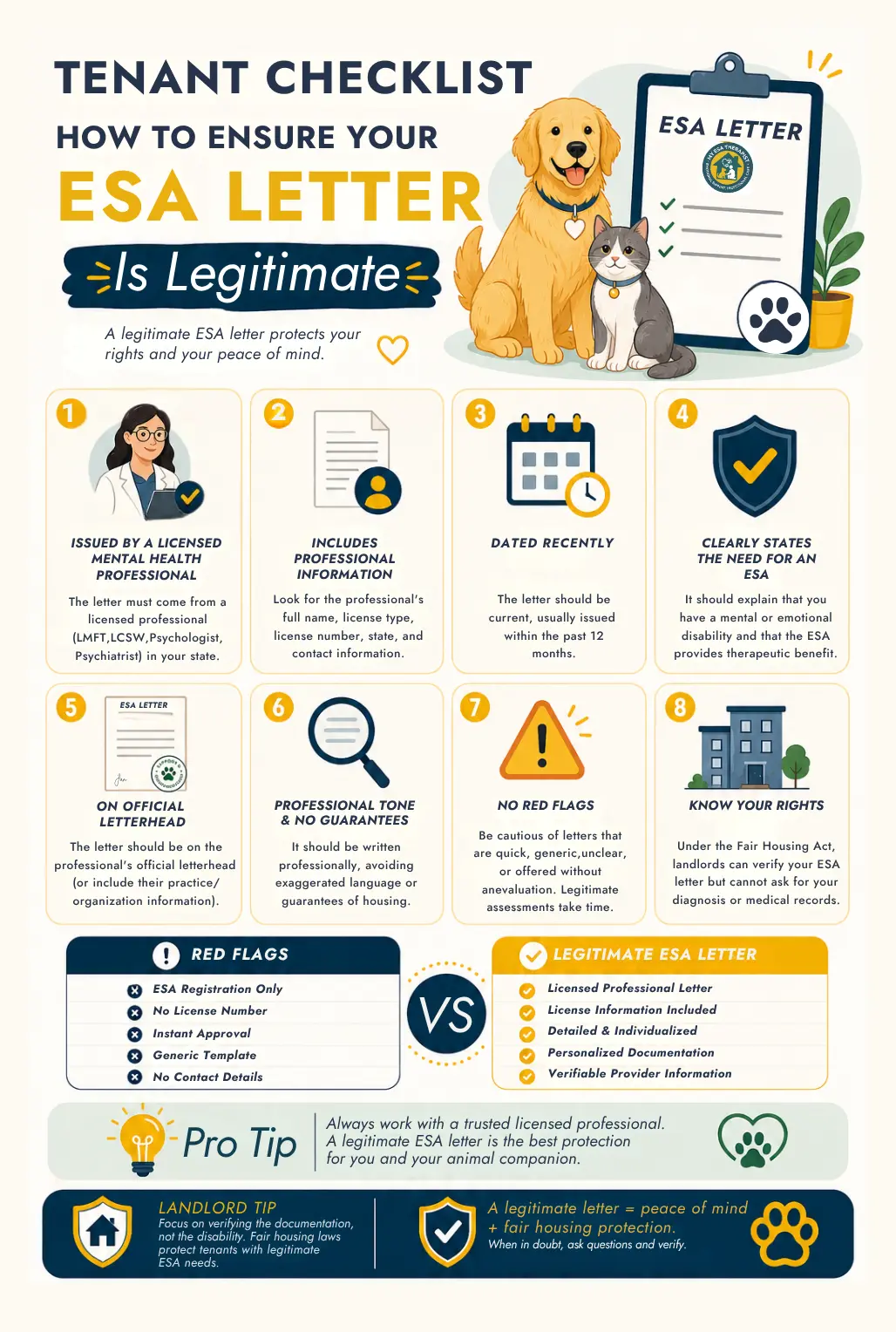
Tenant Checklist: How to Ensure Your ESA Letter Is Legitimate
Confirm the Provider is Licensed
This may include:
- Licensed Professional Counselors (LPCs)
- Licensed Clinical Social Workers (LCSWs)
- Psychologists
- Psychiatrists
- Licensed Marriage and Family Therapists (LMFTs)
The provider should be legally authorized to practice in your state. While primary care doctors/general physicians (MDs/DOs) can legally write ESA letters, many do not feel comfortable making a mental health evaluation and will often refer their patient out to a licensed mental health provider.
Verify the Letter Includes Professional Information
- The provider’s full name
- Professional license number
- State of licensure
- Contact information
- Official letterhead
- Date of mental health assessment
Missing professional credentials may raise concerns about the document’s validity.
Ensure the Letter Is Personalized
Generic ESA letters are often red flags. The letter should include the ESA owner’s name, date of birth, and how the ESA supports them in managing specific symptoms of their disability. Remember, the disability/diagnosis itself does not need to be disclosed.
A valid emotional support animal letter should be written specifically for the individual and confirm that the professional has evaluated their mental health needs.
Watch for Instant Approvals
- Instant or same-day ESA letters
- Guaranteed approval
- No consultation or assessment required
- ESA registrations as proof of legitimacy
A legitimate ESA recommendation requires an assessment by a licensed professional before a letter can be issued.
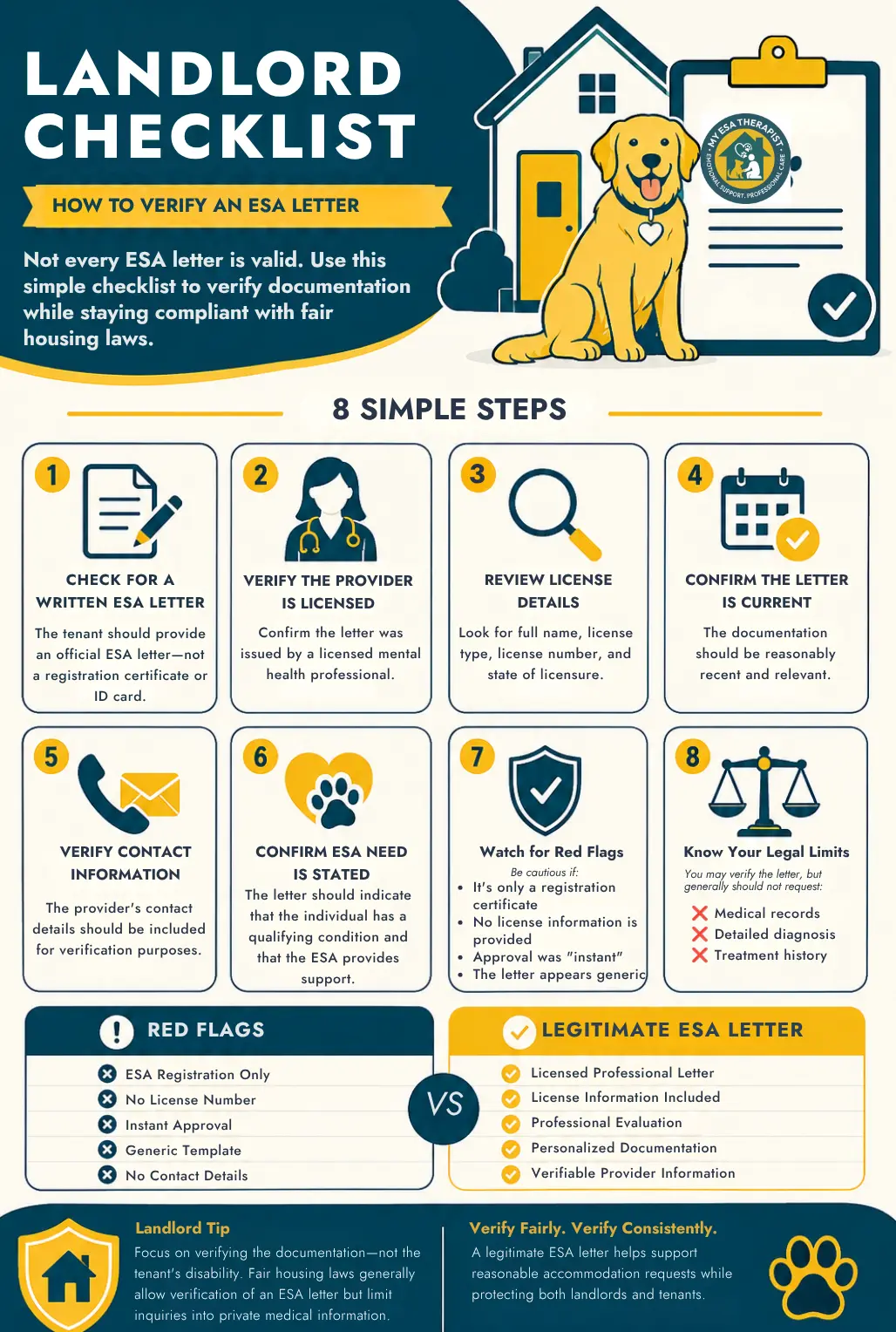
Landlord Checklist: How to Verify an ESA Letter?
Review the Letterhead and Licensing Information
- Professional letterhead
- The provider’s full name
- License number
- State of licensure
- Contact details
- Signature of the licensed provider, not simply a typed name
Professional credentials should be clear and verifiable.
Verify the License
Landlords can confirm whether a mental health practitioner has an active license by using the public licensing databases kept by the majority of states. The NPI Registry Public Search is a free directory of all active National Provider Identifier (NPI) records; most licensed healthcare professionals are required to obtain an NPI number.
The provider’s license status should be active and match the state listed on the ESA letter.
Confirm the Provider Exists
- The provider authored the letter
- The provider is licensed
- The letter is authentic
Confidential medical records, diagnosis specifics, treatment plans, and other protected health information should not be requested by landlords.
Check for Individualized Language
Legitimate ESA letters are generally specific to the individual and clarify the need for an emotional support animal in a professional manner.
Documents that appear copied, generic, or mass-produced may warrant additional review.
Understand What Landlords Cannot Request
While landlords can verify documentation, they cannot ask for the following:
- Demand detailed medical records, such as progress notes, treatment plans, or entire mental health assessments
- Require disclosure of a specific diagnosis or disability
- Ask about treatment history for the diagnosis or disability
- Charge pet fees for a valid ESA accommodation
Housing providers have to strike a balance between fair housing compliance and verification.
Common Signs of a Fake ESA Letter
Watch for these warning signs:
- No licensed mental health professional involved
- Missing license number
- No provider contact information
- No letterhead for the provider or their mental health practice
- Instant approval without a mental health evaluation
- ESA registration certificates are used instead of a letter
- Generic templates with no personalized assessment
- Claims that registration alone grants legal rights
Remember that there is no official federal ESA registry. A legitimate ESA letter for housing from a qualified professional cannot be replaced by registration websites.
How My ESA Therapist Helps Ensure Compliance?
At My ESA Therapist, individuals connect with licensed mental health professionals who evaluate whether an emotional support animal may be appropriate for their situation.
When qualified, clients receive professionally prepared ESA documentation that includes the information commonly requested by housing providers. The approach is confidential, secure, and designed to align with the latest housing accommodation standards.
Request Housing Accommodations with Confidence
Final Thoughts
As ESA accommodation requests become more common, understanding how to verify an ESA letter benefits both tenants and landlords. A legitimate ESA letter should come from a licensed mental health professional, include verifiable credentials, and reflect an individualized assessment. Generic letters without information specific to the individual pursuing an ESA are a sign of a fake ESA letter.
For tenants, obtaining proper documentation can help support housing rights. For landlords, following a consistent verification process can reduce fraud concerns while ensuring compliance with fair housing obligations.
Taking a few minutes to verify an ESA letter correctly can prevent misunderstandings and create a smoother housing experience for everyone involved.
Frequently Asked Questions
What Makes an ESA Letter Legitimate?
Can a Landlord Verify an ESA Letter?
Are ESA Registration Certificates and ID Cards Legally Valid?
Do ESA Letters Need to Be Renewed?
About the Author

More ESA Resources

ESA Letter Sample: What Does a Legitimate ESA Letter Look Like?
This guide provides an ESA letter sample and...

ESA for Children and Minors: How It Works and Who Signs the Letter?
Learn how children qualify for an emotional support animal, who can sign an ESA letter for minors, and what parents need to know about the evaluation process, housing, and school accommodations.

Is ESA Registration Legit or Required? The Truth About ESA Registration.
Many people believe registering an emotional support animal (ESA) makes it legally recognized, but that’s a common misconception. This article explains why ESA registration, certificates, and ID cards generally have no legal standing, what documentation actually matters for housing accommodations, and how to avoid misleading ESA registration services.